 WildayJS
www.npmjs.com/package/wildayjsOverview
A Full-Stack JavaScript Web Framework Inspired by Ruby on Rails. If you love Ruby on Rails, you will feel familiar with WildayJS.
If you never use Ruby on Rails, you will love WildayJS.
WildayJS is designed to make web development in Node.js simple and enjoyable. Following the principles of convention over configuration, it provides a robust foundation for building web applications with minimal setup.
Open source on GitHub (MIT), published as wildayjs on npm.
In numbers
| Total downloads | 1,176 on npm |
| Versions | 10: nine published on 1 and 2 January 2025, then 0.2.1 on 25 November 2026 |
Counted on 24 November 2026.
Installation
npm install -g wildayjs
Quick Start
# Create a new WildayJS application
  $ wildayjs new my-app
  $ cd my-app
  $ npm install
  $ npm start
Then open http://localhost:3000 in your browser.
Generate a new controller:
  # posts controller
  $ wildayjs generate:controller posts
  $ wildayjs generate:controller posts index show
  $ wildayjs generate:controller posts index show --api
  $ wildayjs generate:controller admin/posts index

  # users controller
  $ wildayjs generate:controller users index show
Then try:
  $ wildayjs db:init
  $ wildayjs generate:model user name:string email:string
  $ wildayjs db:migrate
If you need to generate model with associations and validations:
  $ wildayjs generate:model user name:string email:string:null:false:unique
  $ wildayjs generate:model post title:string body:text user:references
Creating a new user:
  $ wildayjs console
  > const user = new User({ name: "John Doe", email: "john@example.com" });
  > user.save();
  > user.all();
If you need add new columns to a table:
  $ wildayjs generate:migration AddUsernameToUsers username:string
  $ wildayjs db:migrate
Check the data through the API endpoints:
  GET    /api/users
  GET    /api/users/:id
  POST   /api/users
  PUT    /api/users/:id
  DELETE /api/users/:id
Features
- MVC Architecture
- Models: Data handling with validations and associations
- Views: Template rendering with layout support
- Controllers: Request handling and response management
- Database Integration
- Built-in SQLite, MySQL, and PostgreSQL support
- Simple migration system
- Model associations
- Intuitive query interface with ORM
- Routing System
- Convention-based routing
- RESTful resources
- Nested routes support
- Parameter handling
- WildayJS CLI
- Generate models, controllers, and views
- Generate migrations
- Generate seeds
- WildayJS Console
- Interactive console for testing and debugging
- Execute SQL queries
- View and manage database tables
- Execute JavaScript code
Project Structure
my-app/
├── app/
│   ├── controllers/
│   ├── models/
│   └── views/
├── config/
│   ├── application.js
│   ├── routes.js
│   └── server.js
├── db/
│   └── migrations/
├── public/
└── package.json
Tech Stack
- Chalk
- Commander.js
- EJS
- Knex.js
- Node.js
- Objection.js
- Webpack
Architecture
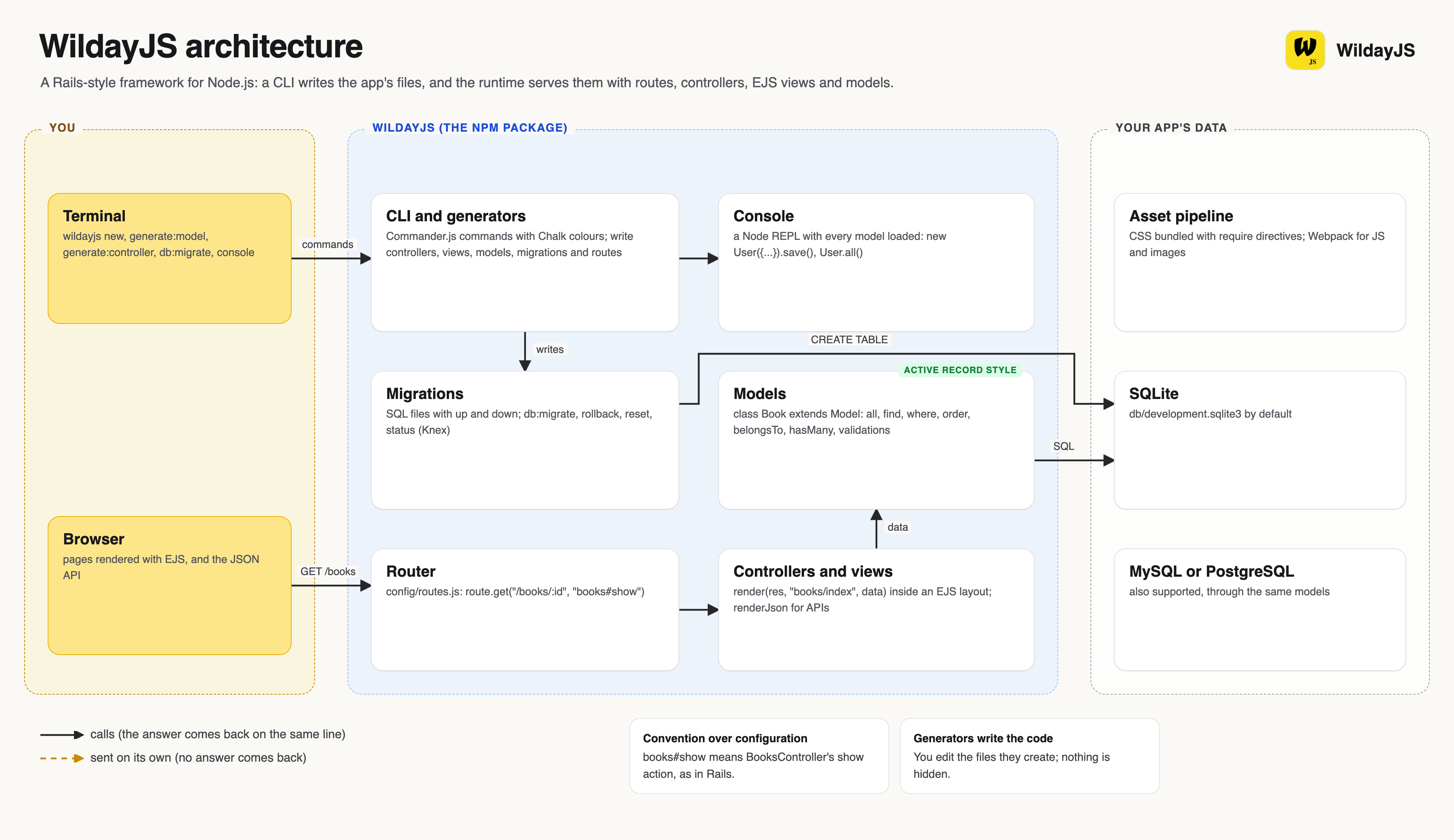
Solid arrows are calls, and the answer comes back on the same line; dashed arrows are sent on their own.
Demo: a Reading List app
Building it
Books
Adding and editing a book
Readers
On a phone
Starter pages and npm
The demo was built with wildayjs 0.2.1 from npm, following the Quick Start: the commands and their output are real. It uses routes with resources, models with validations, hasMany, belongsTo and hasAndBelongsToMany, a before_action that finds the book, forms built with formFor, and redirect after saving.